Summarize this article:
 376 Learners
Last updated on August 5, 2025
Square Root of 167


What is the Square Root of 167?
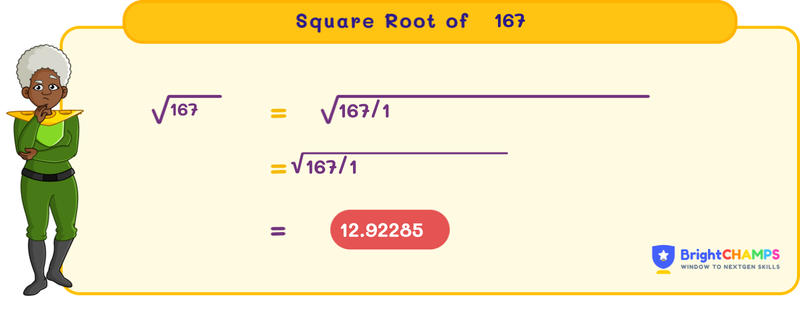
The square root is the inverse operation of squaring a number. 167 is not a perfect square. The square root of 167 can be expressed in both radical and exponential forms. In the radical form, it is expressed as √167, whereas in the exponential form, it is expressed as (167(1/2) .The approximate value of √167 is 12.9228, which is an irrational number because it cannot be expressed as a fraction of two integers.
Finding the Square Root of 167
For perfect square numbers, the prime factorization method is effective. However, for non-perfect squares like 167, the long division method and approximation method are more suitable. Let's explore these methods:
- Prime factorization method
- Long division method
- Approximation method
Square Root of 167 by Prime Factorization Method
Prime factorization involves expressing a number as a product of prime numbers.
For 167, the prime factorization is straightforward since 167 is a prime number itself. Thus, it cannot be factored further.
Since 167 is not a perfect square, we cannot pair its prime factors to simplify the square root. Therefore, calculating √167 using prime factorization is not feasible.
Explore Our Programs


Square Root of 167 by Long Division Method
The long division method is used for finding the square roots of non-perfect square numbers. Here’s how it works for 167:
Step 1: Group the number from right to left. In the case of 167, we group it as (1)(67).
Step 2: Find a number n whose square is less than or equal to 1. Here, n is 1 since 1^2 = 1. The quotient becomes 1, and the remainder is 0.
Step 3: Bring down the next group, 67, making the new dividend 67. Add the previous divisor (1) to itself to get 2, which is part of the new divisor.
Step 4: Consider 2n as the new divisor. We need to find n such that 2n × n ≤ 67. Trying n as 3 gives 23 × 3 = 69, which is too large. Trying n as 2 gives 22 × 2 = 44, which fits.
Step 5: Subtract 44 from 67 to get a remainder of 23.
Step 6: Since the new dividend is smaller than the divisor, add a decimal point and bring down two zeros to make it 2300.
Step 7: Find the new divisor, which becomes 249 (since the previous quotient was 12). Find n such that 249n × n ≤ 2300. Trying n as 9 gives 2499 × 9 = 2241.
Step 8: Subtract 2241 from 2300 to get a remainder of 59.
Step 9: Continue this process to get more decimal places as needed.
Thus, √167 ≈ 12.9228.
Square Root of 167 by Approximation Method
Approximation is a simpler method to estimate square roots. Follow these steps for √167:
Step 1: Identify the closest perfect squares. 144 and 169 are the nearest perfect squares to 167. √167 lies between √144 (12) and √169 (13).
Step 2: Use the formula to approximate: (Given number - smaller perfect square) / (Greater perfect square - smaller perfect square). For 167, (167 - 144) / (169 - 144) = 23 / 25 = 0.92. Step 3: Add the approximation to the smaller square root value: 12 + 0.92 = 12.92.
Therefore, √167 is approximately 12.92.

Common Mistakes and How to Avoid Them in the Square Root of 167
Errors can occur while calculating square roots, such as ignoring the negative root or misapplying methods. Let's examine some common mistakes:
Mistake 1

Forgetting about the negative square root

Students should remember that a number has both positive and negative square roots. Typically, we only use the positive square root, but the negative is equally valid.
For example, √50 = ±7.07.
Mistake 2
Not adding the square root symbol in proper places
Incorrect placement of the square root symbol can lead to errors. Teach students that simplification should happen inside the square root first.
For example, √(12 + 24) = √36, not √12 + √24.
Mistake 3
Not finding the correct value of a non-perfect square
Ensure students understand how to approximate the value of a non-perfect square.
For example, √50 = 7.071067, not simply 7.
Mistake 4
Confusing the square root symbol with the cube root
Students must distinguish between square roots and cube roots.
For example, √50 and ∛50 are different.
Mistake 5
Making mistakes in long division
The long division method involves many steps, and missing any can lead to incorrect results. Ensure students follow each step carefully.



Square Root of 167 Examples


Problem 1
Can you help Max find the area of a square box if its side length is given as √167?

The area of the square is approximately 167 square units.
Explanation
The area of the square = side^2.
The side length is given as √167.
Area of the square = (√167)^2
= 167.
Therefore, the area of the square box is approximately 167 square units.

Problem 2
A square-shaped garden measuring 167 square feet is being designed; if each side is √167, what will be the square feet of half of the garden?
83.5 square feet
Explanation
Since the garden is square-shaped, dividing the total area by 2 gives the area of half the garden.
167 / 2 = 83.5
So, half of the garden measures 83.5 square feet.
Problem 3
Calculate √167 × 4.
Approximately 51.69
Explanation
First, find the square root of 167, which is approximately 12.9228. Multiply this by 4. 12.9228 × 4 ≈ 51.69
Problem 4
What is the square root of (149 + 18)?
The square root is 13.
Explanation
Calculate the sum inside the parentheses: 149 + 18 = 167.
The square root of 167 is approximately 12.9228, which rounds to 13.
Therefore, the square root of (149 + 18) is approximately 13.
Problem 5
Find the perimeter of a rectangle if its length ‘l’ is √167 units and the width ‘w’ is 40 units.
The perimeter of the rectangle is approximately 105.85 units.
Explanation
Perimeter of the rectangle = 2 × (length + width)
Perimeter = 2 × (√167 + 40)
= 2 × (12.9228 + 40)
≈ 105.85 units.

FAQ on Square Root of 167
1.What is √167 in its simplest form?

2.Mention the factors of 167.
3.Calculate the square of 167.
4.Is 167 a prime number?
5.167 is divisible by?
Important Glossaries for the Square Root of 167
- Square root: The number that, when multiplied by itself, gives the original number. Example: √16 = 4 because 4 × 4 = 16.
- Irrational number: A number that cannot be expressed as a simple fraction, with a non-repeating and non-terminating decimal. Example: √2.
- Prime number: A natural number greater than 1 that has no positive divisors other than 1 and itself. Example: 167.
- Approximation: The process of finding a value that is close to but not exactly equal to a specific number.
- Perfect square: A number that is the square of an integer. Example: 144, as 12 × 12 = 144.

More topics related to Square Root of 167
![Important Math Links Icon]() Related calculations for Square Root of 167
Related calculations for Square Root of 167

![Important Math Links Icon]() Topics commonly learned together
Topics commonly learned together
![Important Math Links Icon]() Previous to Square Root of 167
Previous to Square Root of 167
![Important Math Links Icon]() Other topics in Square Root of a Number
Other topics in Square Root of a Number
![Important Math Links Icon]() Explore More Algebra Topics
Explore More Algebra Topics
![Important Math Links Icon]() Algebra category quick links
Algebra category quick links


Jaskaran Singh Saluja
About the Author
Jaskaran Singh Saluja is a math wizard with nearly three years of experience as a math teacher. His expertise is in algebra, so he can make algebra classes interesting by turning tricky equations into simple puzzles.
Fun Fact
: He loves to play the quiz with kids through algebra to make kids love it.


