Summarize this article:
 257 Learners
Last updated on August 5, 2025
1719 in Words


1719 in Words
Before we learn more about 1719 in words, let’s first understand a few basic rules. Always spell out numbers at the beginning of a sentence instead of writing the numeral.
Another thing to remember is to use a hyphen for fractions (e.g., one-third) and compound numbers like twenty-one or fifty-six. These are some basic rules one must always keep in mind when writing numbers in words.
How to write 1719 in words?
Writing numbers in words is essential when filling out official documents or checks. But how do we write a number like 1719 in words? The answer lies in breaking the number into its place values.
Let’s look into how we represent 1719 in its place values with the help of a place value chart. For 1719, we split the number into thousands, hundreds, tens, and ones. 1 represents the thousands place, 7 represents the hundreds, 1 represents the tens, and 9 represents the ones.
Step 1: Begin with the leftmost digit and assign each digit a place value as you move from left to right. For 1719, we start from thousands, hundreds, tens, and then the ones place.
Step 2: Next, combine the values from each place and then read the values aloud. In 1719, we see the number consists of 9 ‘ones’, 1 ‘ten’, 7 ‘hundreds’, and 1 ‘thousand’. Starting from the leftmost value, read the number together from left to right, keeping in mind the place values.
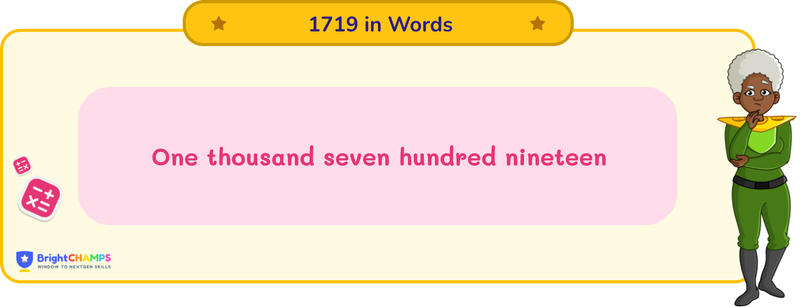
When we read it aloud, we say “one thousand seven hundred nineteen”.
Learn More About the Number 1719
Now that we have learned how to express the number 1719 in words, let us learn more about its properties.
Explore Our Programs


Common Mistakes and How to Avoid Them in 1719 in Words
The following points are a few common mistakes people make when writing numbers into words. It can get a little confusing:
Mistake 1

Not placing digits in the correct place value order.

We must always ensure that the correct place value is used. A hyphen should be used to separate tens and ones in compound numbers from twenty-one through ninety-nine.
Example:
Incorrect: Seventeen nineteen
Correct: One thousand seven hundred nineteen
Mistake 2
Removing the zero when reading the words aloud
When reading numbers like 205 or 4001, people may sometimes assume that 0 needs to be omitted, which is incorrect. This affects the pronunciation of the number. Make sure zero is included as part of the number’s place value.
Example:
Incorrect: 205 (if we omit the zero, we read it as twenty-five)
Correct: 205 should be read as two hundred five
Mistake 3
Confusing similar sounding words with each other and making spelling mistakes.
There are a few numbers that have very similar sounds. We must ensure clarity with the pronunciation of the number. We must also make sure that when writing the numbers in words, we avoid spelling mistakes.
Example: Sixteen being mistaken as sixty. 1719 being written as one thousand seven hundred nineteen.
Mistake 4
Overuse of the word ‘and’
Overusing the word ‘and’ is a common mistake. This is especially prevalent in larger numbers.
Example:
Incorrect: 137 = One and hundred and thirty-seven
Correct: 137 = One hundred thirty-seven (notice the placement of ‘and’)
Mistake 5
Reading or writing the numbers in the wrong order.
When people start learning about writing numbers in words, they may struggle with the sequence of numbers. It is important to stress the importance of place values. Begin from the largest number to the smallest number.
Example:
Incorrect: 1,719 = One thousand seventy-one hundred and nine
Correct: 1719 = One thousand seven hundred nineteen


FAQs on 1719 in Words
1.What is the importance of writing numbers in words?

2.Can I write 1719 as 1.7k?
3.What are a few rules we must follow to write 1719 in words?
4.What is 1234 + 485 in words?
5.Should we use commas when writing numbers in words?
Important Glossaries for 1719 in Words
- Place value: The position of the digit in the place value chart. For example, in 1,719, the place value of 1 is thousand.
- Compound numbers: Numbers that involve a hyphen when written in words, such as twenty-one or fifty-six.
- Numerals: Symbols or group of symbols that represent a number. For example, 1719 is a numeral.
- Digits: The individual numbers 0-9 that make up numerals. For example, 1, 7, 1, and 9 are the digits in 1719.
- Hyphenation: The use of a hyphen in compound words and numbers, such as twenty-one.



More topics related to 1719 in Words
![Important Math Links Icon]() Related calculations for 1719 in Words
Related calculations for 1719 in Words

![Important Math Links Icon]() Other topics in Number Names
Other topics in Number Names
![Important Math Links Icon]() Explore More Numbers Topics
Explore More Numbers Topics
![Important Math Links Icon]() Numbers category quick links
Numbers category quick links



Hiralee Lalitkumar Makwana
About the Author
Hiralee Lalitkumar Makwana has almost two years of teaching experience. She is a number ninja as she loves numbers. Her interest in numbers can be seen in the way she cracks math puzzles and hidden patterns.

Fun Fact
: She loves to read number jokes and games.


